The Hamilton Correspondence
William Douglas-Hamilton occupied a unique position in the Scottish Revolution of 1689. Unlike many of his peers, he navigated the transition from the Stuart to the Williamite regime without losing either his offices or his influence. Network analysis of his surviving correspondence reveals how he managed this: not through loyalty to any single political sphere, but through his structural position as a bridge between them — connecting the monarchy, parliament, the Privy Council, his own family network, and regional power in Scotland simultaneously. Where Melville's network was institutional and state-heavy, Hamilton's was heterogeneous, mixing formal governance with personal patronage, family obligation, and regional authority in ways that made him indispensable to the new regime.
Hamilton served under both Charles II and James II before becoming one of the first Scottish noblemen to reach out to the future William III and Mary II. Under the Williamite administration he held two of the most powerful offices in Scotland simultaneously: High Commissioner to the Scottish Parliament and President of the Privy Council. He presided over the Convention of Estates, summoned at his own request, formally offered the Scottish crown to William and Mary in March 1689 after declaring that James VII had forfeited it under the Claim of Right.1 Anne Shukman has argued that Hamilton was an experienced and wily politician who sat on vitally important committees, including those for preparing acts and granting supply. Hamilton was also willing to remain staunchly loyal to the monarch no matter who he or she was.2 He also presided over the Convention of Estates in Scotland, that was summoned at his request, and eventually offered the Scottish crown (which James had according to the Claim of Right "forefaulted") to William and Mary in March 1689.
The Collection
Hamilton's correspondence is dense and varied. Unlike the Leven and Melville Papers during the Revolution it is not all neatly published in one place or in one collection but scattered. The analysis on this collection is incomplete but telling. Hamilton's correspondence is scattered across multiple repositories and collections, and the analysis presented here is ongoing. The core dataset draws on GD406/1 at the National Records for Scotland. The Papers of the Douglas Hamilton Family, Dukes of Hamilton and Brandon — and contains 317 letters, 7 intercepted letters, warrants, orders, accounts, and proclamations spanning 1688 to 1692. Additional correspondence exists in other pockets of the wider GD406 collection and in printed collections held elsewhere, and this material is being incorporated as the project develops. Readers should treat the findings below as a work in progress: the patterns identified are robust, but the full picture will become clearer as the dataset expands. Hamilton’s position as President of the Privy Council and High Commissioner meant that he operated at the interplay of politics and security and, together with the Treasury and Secretary of State, he provides an important locus point for this investigation. Named individuals were disambiguated and classified by role, allegiance, and institutional affiliation, yielding 408 nodes (264 people, 126 places, 18 orgs/groups), 664 edges with 312 letter links from a total of 938 source records. Edge weights were assigned to reflect the volume of correspondence between nodes. The resulting dataset was then analyzed using standard network metrics — degree centrality, betweenness centrality, and clustering coefficients — computed in Python, with both a network produced in D3.js and mapped using Leaflet.js.
Hamilton’s Network
Before reading the analysis below, explore the network graph. Several features are immediately visible: Hamilton sits at the center of a dense cluster, but unlike Melville's predominantly institutional hub, Hamilton's network radiates outward into distinct spheres — family, secretarial, parliamentary, and royal — that overlap only through him. His secretary David Crawford appears as a major secondary node, handling the volume of day-to-day correspondence that flowed through Hamilton House. Look also for the clusters around the Earl of Arran, Lady Gerard, and the Duchess of Hamilton — personal relationships that have no equivalent in Melville's more state-focused correspondence.
The Hamilton Papers (GD406/1)
Dukes of Hamilton & Brandon · 1688–1702 · Drag to pan · Scroll to zoom
Node Type
Controls
The Shape of Hamilton’s Network
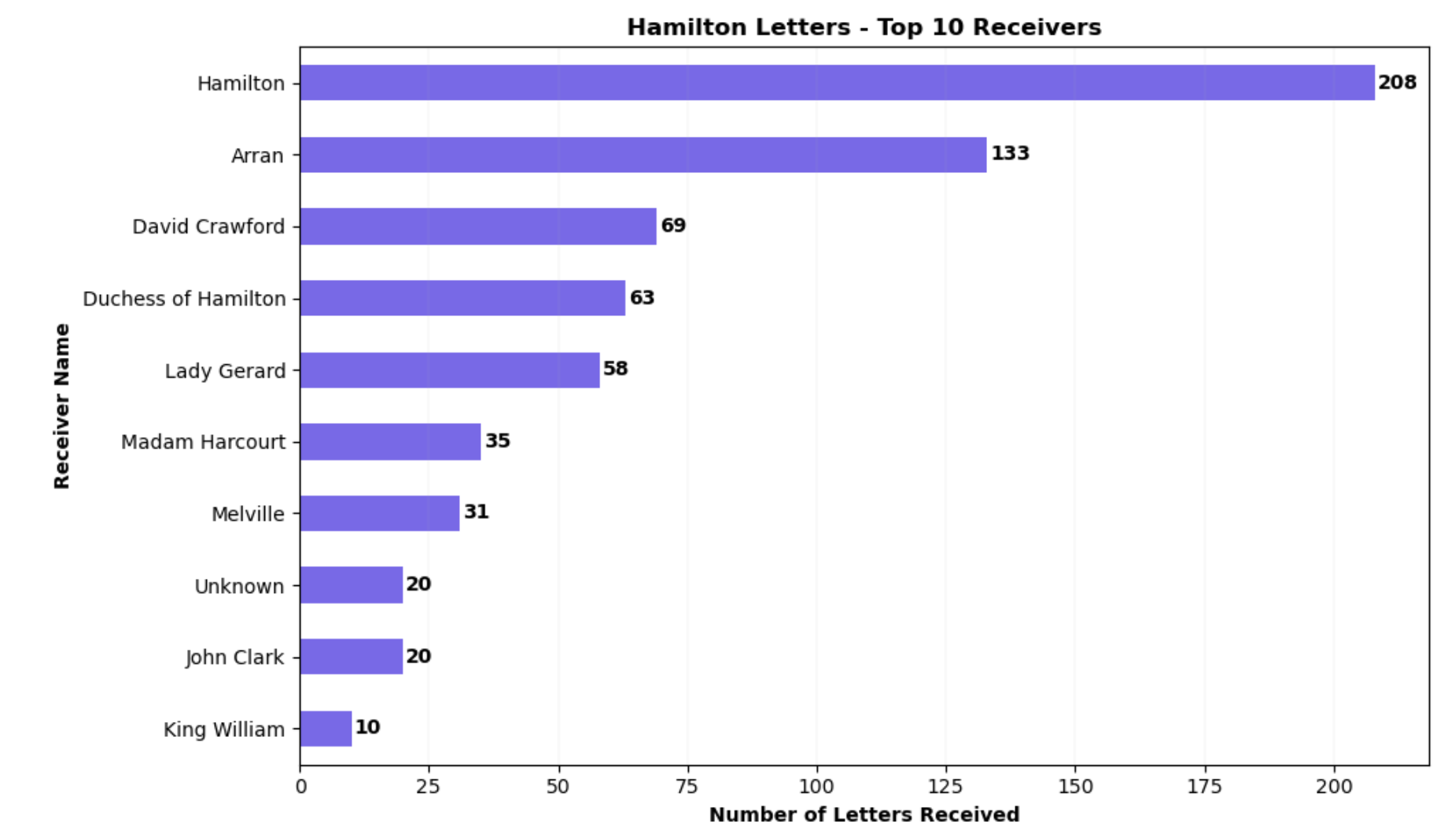
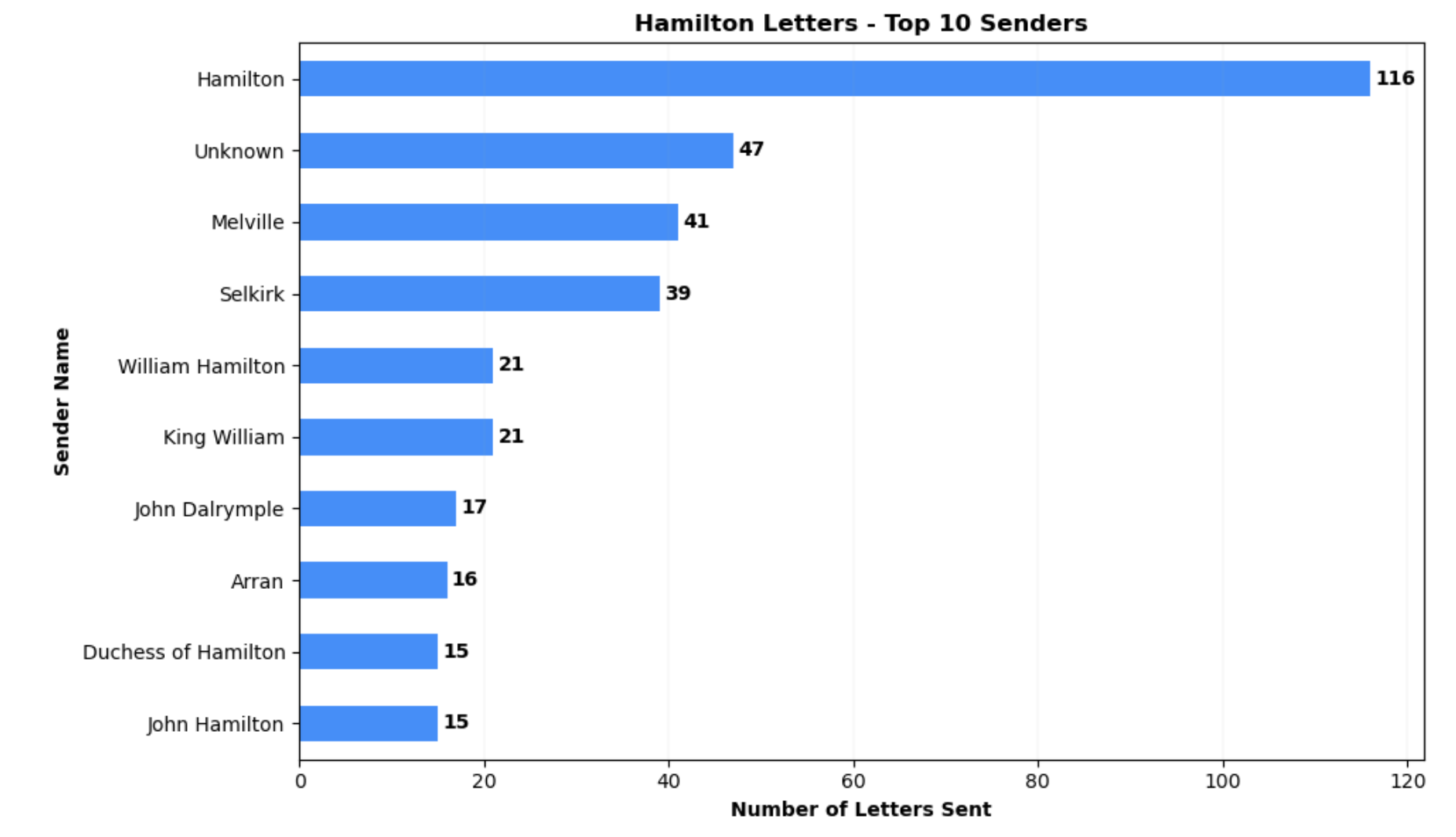
Hamilton's networks were dense. Much of his correspondence flowed through his secretary David Crawford. Which isn't that surprising given Crawford handled much of Hamilton’s day-by-day business including any requests for money or work that flowed through the Hamilton House. Degree centrality in Hamilton's network confirms his dominance as a correspondent hub. Hamilton himself registers the highest degree centrality in the corpus at 79. He is followed by his son the Earl of Arran (44), his secretary David Crawford (38), Lady Gerard (33), an unknown sender (27), and the Duchess of Hamilton (17). Eight distinct clusters are visible in the graph, centered on Hamilton, Crawford, Arran, the Duchess, John Clark, Lady Gerard, Madam Harcourt, and an unknown sender. The dataset encompasses correspondence collected through two methods: manuscript transcription and metadata collection from the NRS catalogue. The network reflects the metadata layer, which is why some letters record no sender or recipient — either the name is absent from the original or remains unclear from the manuscript. The networks present reflect the metadata collection rather than the transcriptions themselves, primarily because we can reconstruct that connective network through the detailed metadata available at the National Records for Scotland. This fact also accounts for the absence of a sender or receiver in some of the letters - where either the name is unclear or not present.
The papers included here constitute both state and personal papers. That is why there are distinct hubs outside of state relationships with the monarch and the privy council. The degree centrality rankings reveal something that distinguishes Hamilton's network from Melville's: it is heterogeneous. The top nodes are not exclusively monarchs, secretaries, and institutional bodies — they include a secretary, a son, a wife, and two women whose primary relationship to Hamilton was personal rather than political. This reflects the nature of the collection itself, which combines state papers with personal correspondence in a single archive. But it also reflects something real about how Hamilton exercised power. His influence did not flow only through formal channels; it was sustained and mediated by a dense web of personal relationships that overlapped with his public role. Crawford is the clearest example: as Hamilton's secretary he handled requests for money, patronage, and employment, functioning as a gatekeeper between Hamilton's public office and the individuals seeking access to it. His high centrality is not incidental — it is structural, a consequence of Hamilton's reliance on a trusted intermediary to manage the volume of correspondence his dual offices generated. In terms of clustering, within the graph there are clusters present around the Duke of Hamilton, Lady Gerard, David Crawford, the Earl of Arran, John Clark, the Earl of Perth, and King William.
The Unknown sender node registers a betweenness centrality of 0.48 — second only to Hamilton himself, and substantially higher than Arran (0.39) or Crawford (0.23). This is one of the most analytically interesting features of the graph and currently goes entirely unremarked in the text. A betweenness score that high for an anonymous node means that a significant proportion of the network's bridging paths run through correspondence where the sender cannot be identified. There are several possible explanations worth exploring. Some correspondents may have withheld their names precisely because the content of their letters was sensitive — intelligence reports, accusations, requests that could not be made openly. Another explanation might be archival loss or letter readability: the sender's name may have appeared on a wrapper or cover letter that has not survived. It could also be institutional correspondence: letters sent on behalf of a body rather than an individual (a committee, a garrison, a court) might record no personal sender. The high betweenness of the Unknown node suggests this is not a marginal problem — it sits at the heart of the network's bridging structure, which means the analysis as currently constituted has a significant gap at its center that warrants explicit acknowledgment and further archival investigation.
Who are the bridges?
Betweenness centrality measures how often a node sits on the shortest path between two other nodes — in a letter network, it identifies the individuals without whom communication between different parts of the network would be slower or impossible. The highest betweenness centrality scores in the Hamilton corpus are:
- Hamilton (0.8)
- Unknown (0.48)
- Arran (0.39)
- David Crawford (0.23)
- King James (0.22)
- Lady Gerard (0.22)
- John Dalrymple (0.19)
- Argyll (0.13)
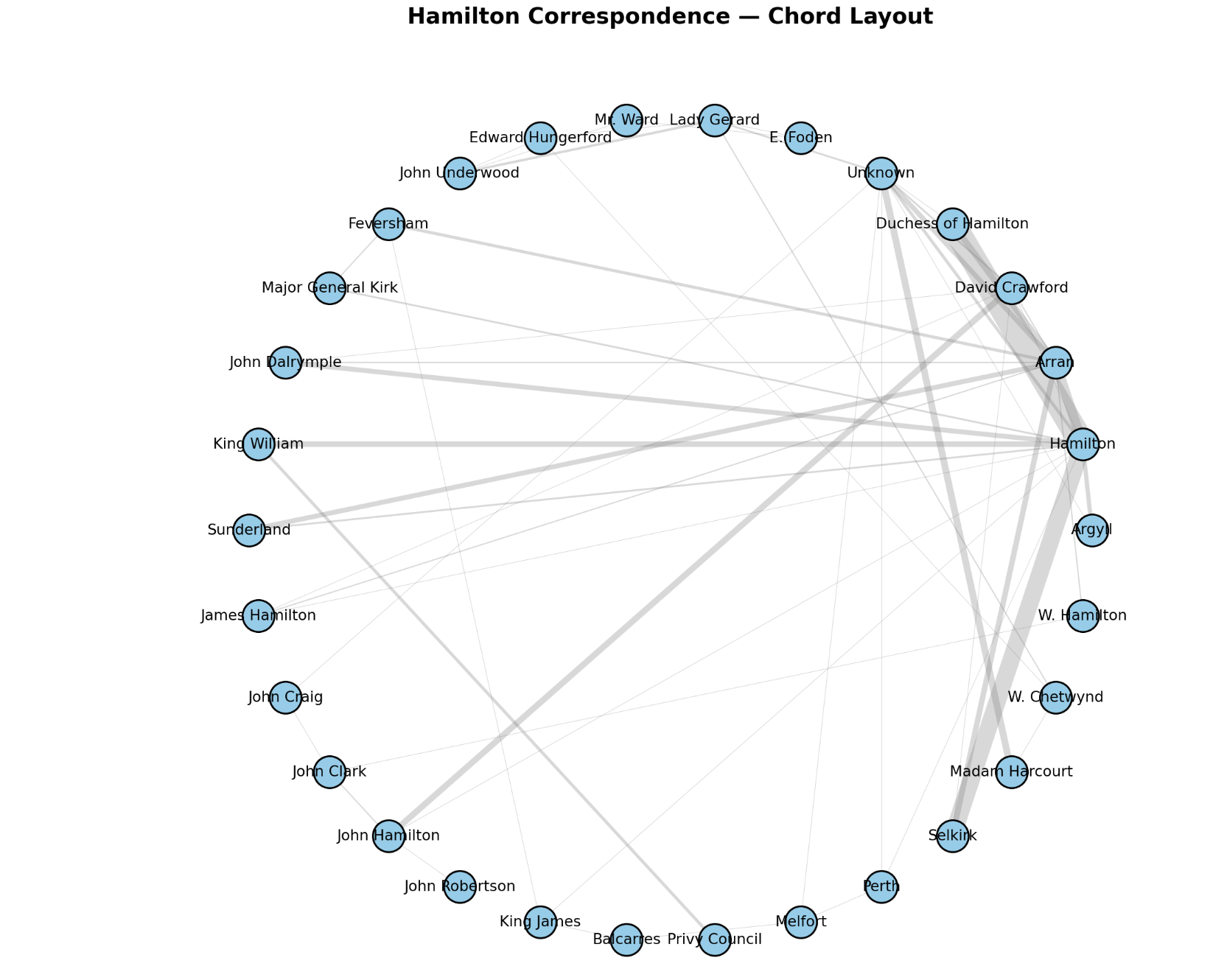
Reading these scores as a ranked list obscures what they collectively reveal. Grouping the key figures by role makes the argument clearer. Hamilton himself sat as the High Commissioner for Parliament and on several defense committees and the privy council. He had an extensive network of communication as evinced by the graph, which included diplomats, kings, and spies.
The family and secretarial network—Arran, Crawford, and the Duchess—appear in both the degree and betweenness rankings, meaning they were not just frequent correspondents but active intermediaries routing communication between Hamilton and others. Arran in particular occupied a complicated position: accused of Jacobite sympathies on multiple occasions because of his position in the western islands, he nonetheless remained a central node in his father's correspondence network, bridging Hamilton’s Williamite public role and the more ambiguous politics of the Scottish periphery.The political-military travelers—Argyll and Dalrymple—register high betweenness because of their physical mobility. They are the political equivalents of diplomats and physically travelled around Scotland meaning their connective tissues were denser than the average letter receiver in the network. Argyll was dispatched on expeditions throughout the period, including operations to suppress insurrection in the western islands. Dalrymple served simultaneously in the Privy Council, the Scottish Parliament, and as one of William’s closest Scottish advisors alongside his father James. Like diplomats, men who moved physically between centers of power accumulated bridging roles that gave them disproportionate influence over information flow. Their high betweenness scores are a quantitative reflection of their political indispensability. Each provided information, intelligence, and status updates of campaigns and their recommendations on next steps.
The monarchical nodes—King James registers a betweenness score of 0.22, largely through the intercepted letters present in the collection. His appearance in Hamilton’s network is a reminder that the Williamite correspondence archive was not a sealed system: intelligence about the Jacobite court flowed into it through interception, making Hamilton's network a site of counter-intelligence as well as administration. King James' betweenness score tells us something even more important: those intercepted letters were not peripheral to the network. They connected nodes that would otherwise have been disconnected, meaning the intelligence gathered through interception was structurally integrated into Hamilton's correspondence operation rather than sitting as an isolated curiosity. This reframes Hamilton's role slightly. He was not only High Commissioner and President of the Privy Council — he was also, in a meaningful sense, running a counter-intelligence operation, and the intercepted correspondence was part of the active information infrastructure of his office.
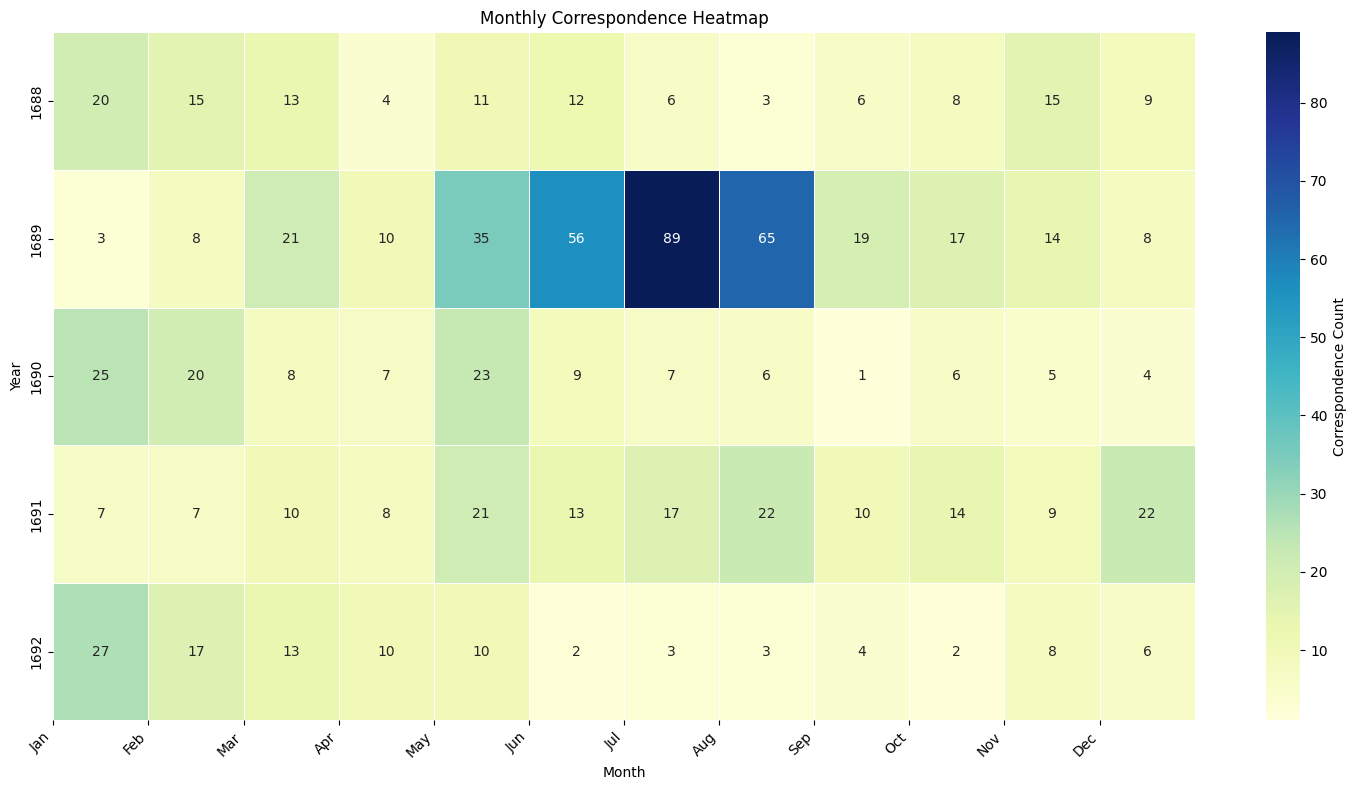
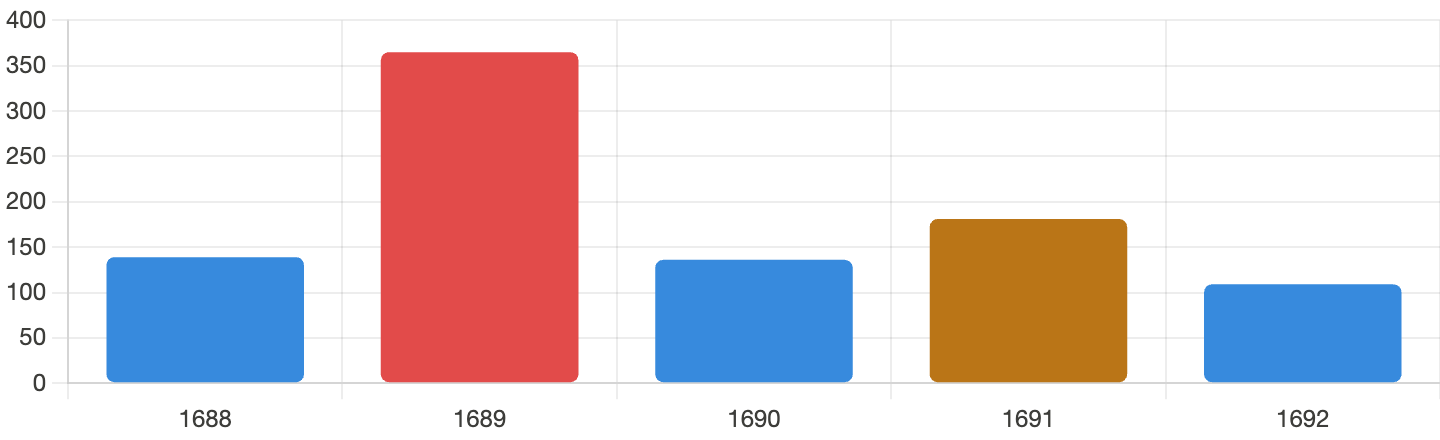
Together these three groups define what Hamilton's bridging role actually consisted of: he sat at the intersection of family obligation, parliamentary politics, regional military authority, and royal intelligence—and his network held those spheres in relation to each other. The temporal distribution of Hamilton's correspondence is heavily concentrated in the years 1689–1690, with a significant spike in 1689. This pattern reflects the intense political activity and communication demands of the immediate post-Revolution period, as Hamilton navigated the complex transition of power and the ongoing Jacobite threat. The year 1689 stands out as a critical moment in Hamilton's network, with a surge in correspondence that underscores his central role in managing the political and military challenges of the time.
Where did Hamilton's Network Reach?
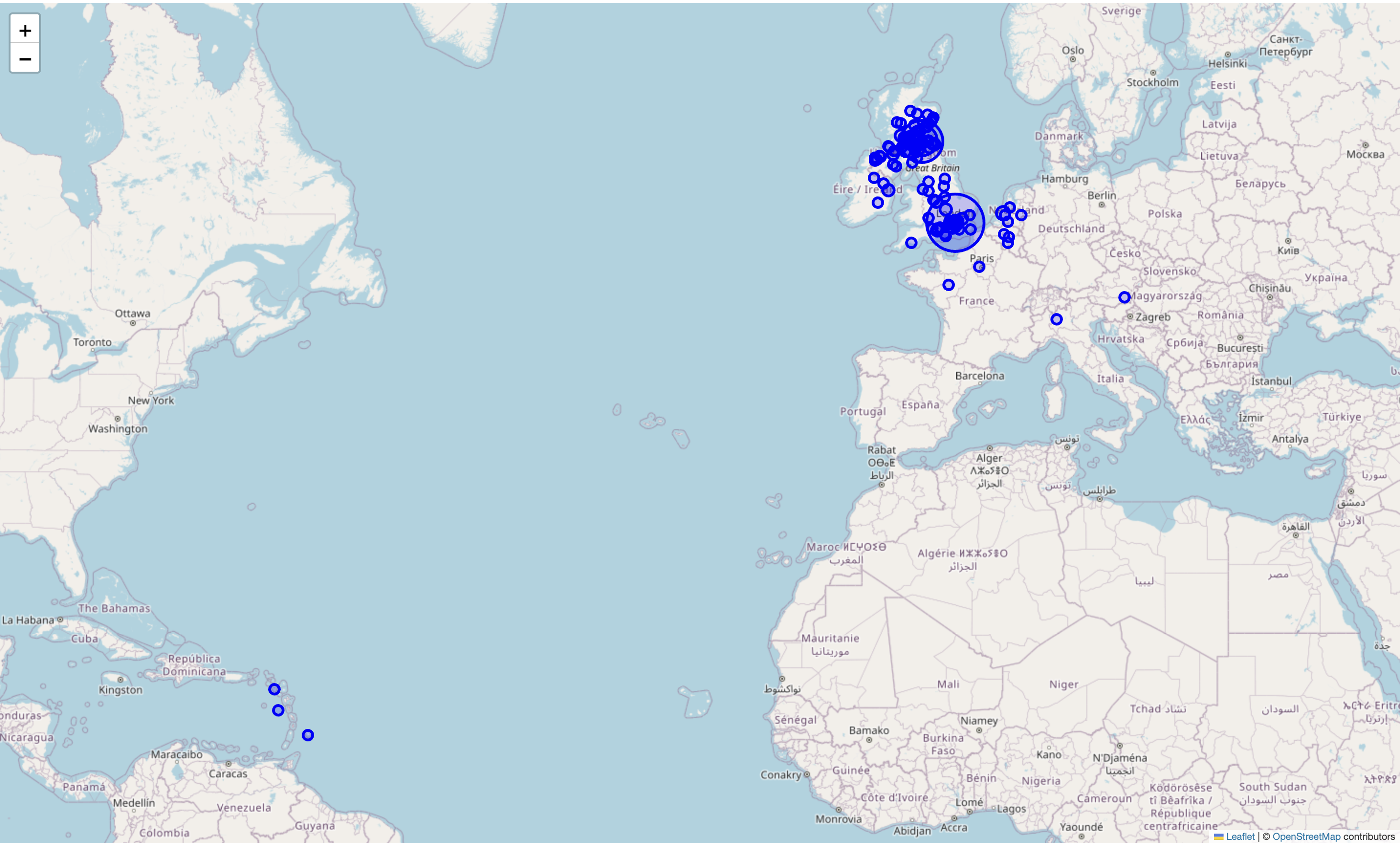
Hamilton’s correspondence is geographically dispersed. The letters in the collection were sent to and from locations across Scotland, England, Northern Europe, and the sugar colonies. Hamilton's correspondence was geographically dispersed, extending across Scotland, England, northern Europe, and notably the sugar colonies of the Atlantic world. The full geographic analysis is forthcoming, but the map below gives an initial picture of the spatial reach of his network. The presence of correspondence nodes in the Atlantic colonies is a detail that warrants attention: it places Hamilton's network within the broader context of Scottish involvement in Atlantic commerce and colonial enterprise in the late seventeenth century, a dimension entirely absent from Melville's more domestically focused correspondence. For the combined geographic analysis of both Hamilton and Melville's networks, see the Melville & Hamilton Map.
The Hamilton papers document the Scottish Revolution settlement through several distinct but interconnected channels of correspondence. At their heart is the Hamilton–Melville dyad: 137 letters exchanged between Hamilton at Holyrood and Melville in London, sometimes at a daily pace through the critical months of July and August 1689. This was not personal correspondence but a state communication channel — royal government operating by post, with every letter carrying political intelligence, instruction, or negotiation over the Kirk settlement, the Jacobite rising, and parliamentary management. Holyrood Palace itself was more than a physical address; as the administrative heart of Hamilton's operations and the seat of his authority as Lord High Commissioner — effectively William III's viceroy in Scotland — it appears in 106 of the collection's 139 total mentions of the palace in 1689 alone, making the London–Holyrood corridor the nervous system of the Revolution settlement.
Surrounding this central axis are three more specialized clusters that illuminate the wider political moment. The 16 letters from Lord Feversham to Arran, dispatched from Salisbury and Beaconsfield across November and December 1688, offer a remarkably intimate view of military collapse, tracing the disintegration of James II's army along the very route of William of Orange's march on London. Preserved because Arran, Hamilton's son, held a regimental colonelcy in that army, they read as dispatches from a royalist command in freefall. Meanwhile, the 13 Dublin Castle interceptions — all dated 28–29 March 1689 and including two letters from James II himself to Dundee and Balcarres — capture Hamilton operating in a different register entirely: not as correspondent but as intelligence officer, receiving the intercepted communications of his Jacobite opponents and mapping their network in Scotland. Finally, a tight cluster of nine letters mentioning The Hague, all from 1691–92, reflects the temporary relocation of the Williamite court to the continent during the Nine Years' War, with John Dalrymple serving as intermediary between William III and Hamilton — a reminder that the Revolution settlement was being managed across a theatre far wider than Scotland alone.
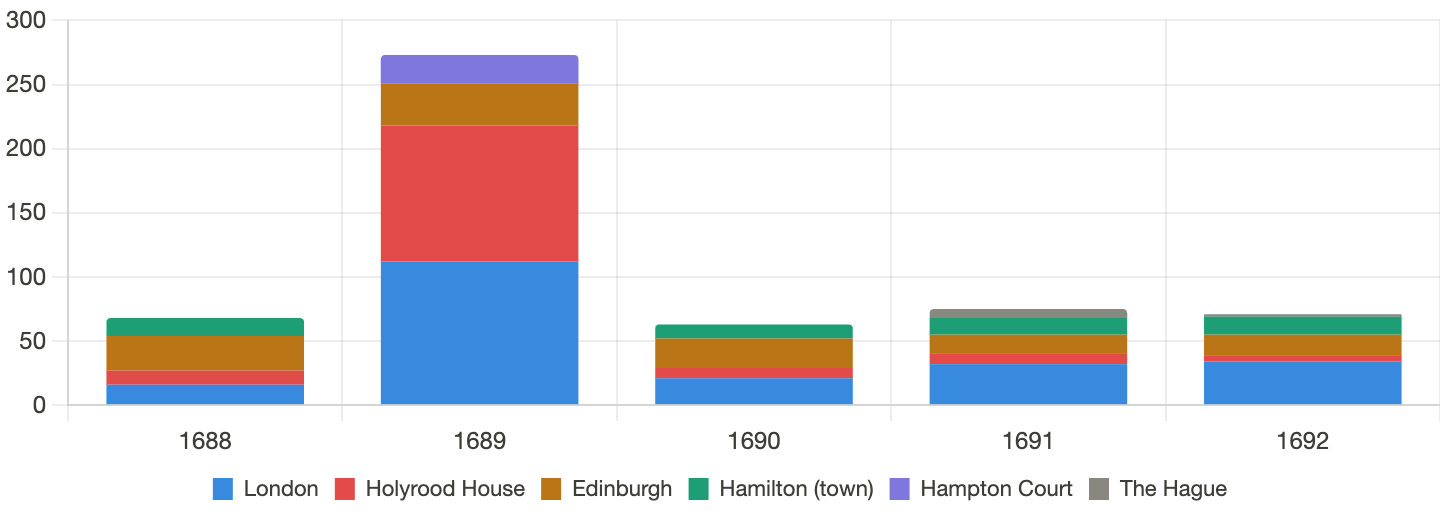
Hamilton's network didn't simply survive the Revolution — it was actively receiving intelligence from both sides of it simultaneously. That is what his structural position as a bridge actually looked like in practice. The 137 letters between Hamilton and Melville, exchanged at sometimes daily intervals through July–August 1689, are one of the most important single correspondence relationships in the dataset. Daily exchange between the High Commissioner in Edinburgh and the Secretary of State in London means the two men were effectively operating as a distributed executive — one holding the parliamentary and administrative front in Scotland, the other managing the relationship with the King and the wider British and European context. Every letter in that exchange was a decision point: about how to handle the Kirk settlement, how to respond to Dundee's rising, how to manage parliamentary resistance. The pace of exchange — daily through the peak crisis months — tells us something about how the regime understood the situation. This was not a government that felt it could afford to wait a week for a reply. The velocity of the Hamilton–Melville correspondence is itself evidence of how close to the edge the Williamite settlement felt from the inside. William was frequently not in Britain, and the Scottish administration had to function through correspondence chains that could stretch from Edinburgh to wherever the King's court happened to be on the continent. The Hague cluster is evidence of that problem and of the solution: Dalrymple as a mobile intermediary, maintaining the connection between Hamilton's Edinburgh operation and the peripatetic Williamite court. His high betweenness score shows he was literally moving between nodes that were otherwise separated by geography and war. The presence of the intercepted letters is significant in its own right, 28–29 March 1689 is just weeks after the Convention opened (14 March) and days after the crown was formally offered to William and Mary (11 April). Hamilton was intercepting Jacobite intelligence at the precise moment he was presiding over the transfer of sovereignty. The Dublin letters are not background context — they are evidence of the regime operating in two modes simultaneously: constructing constitutional legitimacy through the Convention while gathering military intelligence through interception.
1. The Records of the Parliaments of Scotland to 1707, K.M. Brown et al eds (St Andrews, 2007-2026), 1689/3/108. Date accessed: 13 April 2026; The Claim of Right in 1689, https://www.wikidata.org/wiki/Q12407381.
2. Anne Shukman, “The Fall of the Episcopacy in Scotland 1688-1691” (MPhil diss., University of Glasgow, 2011), p.17.